How Japan Plays: 5 uniquely Japanese ways to have fun (and what they actually cost)
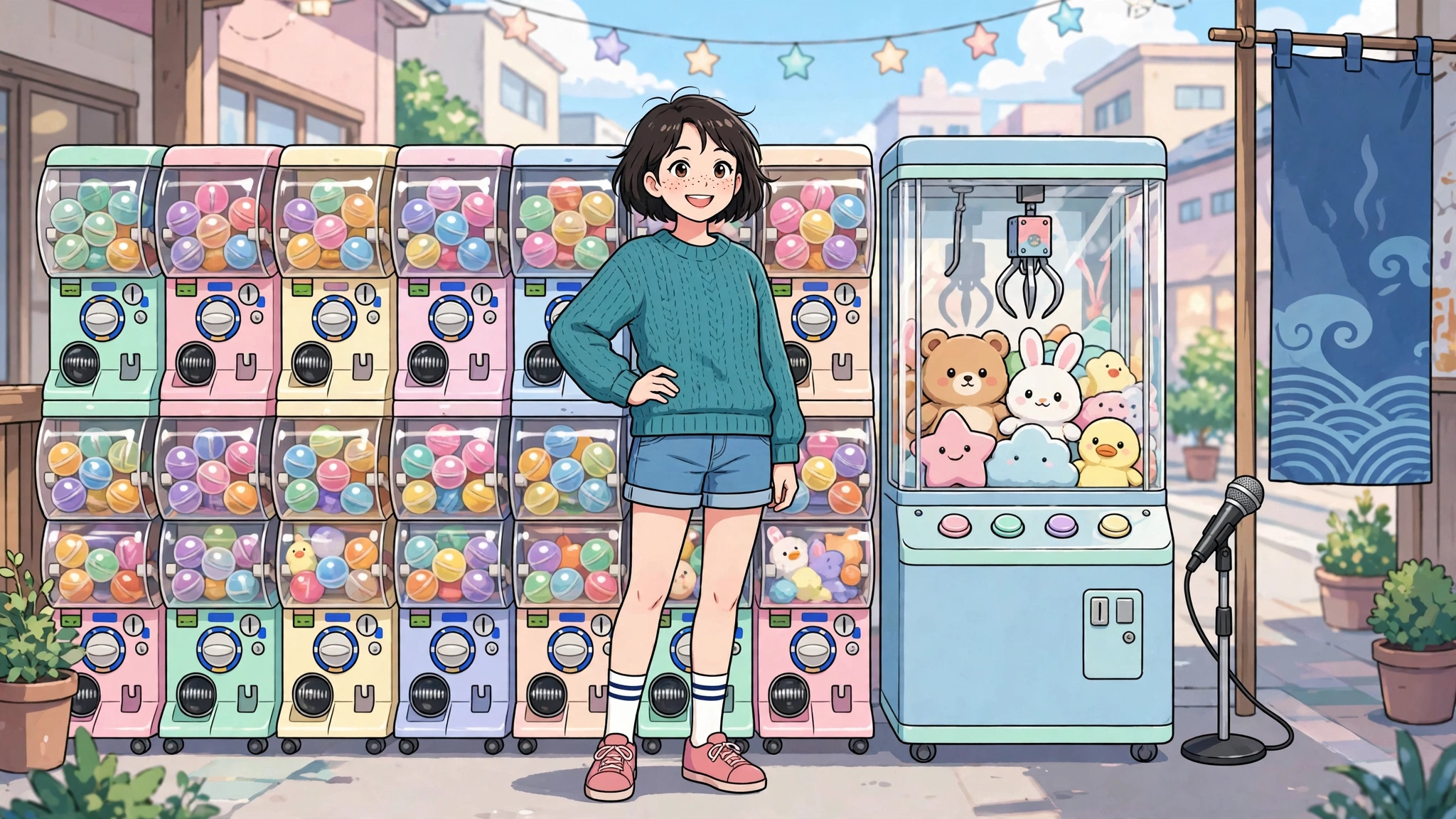
* The eyecatch is an illustration, not a photo.
Japan does not really sell "fun" in bulk. It sells fun the way it sells everything else: in small units, at a posted price, with a short set of steps you are expected to follow exactly. A capsule toy is one turn of a handle. A song is rented by the half hour. A bath costs the same at every bathhouse in Tokyo because the city government sets the price.
I read price tags for a living, so I read play the same way I read products. Below are five ways Japan has fun — how each system actually works, what it costs at the prices I could verify, where first-timers get stuck, and the small moves regulars make. No nostalgia, no "hidden gem" language. Just the mechanics and the money.
1. Gacha gacha: the capsule machine that sells you a lottery in plastic
Whole walls of Japanese shops — station corners, arcades, dedicated specialty stores — are covered in capsule machines. Each machine holds exactly one series of small toys or charms: five kinds, say, shown on the card on the front. You pay, turn the handle, and a plastic capsule drops. Which of the five you get is not up to you.
| How it works | Pick a machine (one machine = one series). Pay per turn, turn the handle, capsule drops. The contents are random within the series printed on the machine |
| What it costs | Mainstream Bandai series currently cluster at ¥300–500 per turn (approx. $2–3). Bandai's official shop lineup lists series at ¥300, ¥400 and ¥500 a turn, and many of this month's new releases are ¥300 |
| Where first-timers get stuck | You cannot choose the design. Completing a set of five can take five turns or fifteen, and duplicates are simply yours. There is no "one more try is guaranteed to work" — every turn is the same lottery |
| The local move | Decide your number of turns before you start, not after the second duplicate. Read the lineup card first — if you only want one of the five, the honest price of that one item is "several turns," and regulars treat trading duplicates with friends as part of the game |
The character series are the draw: Sanrio, anime franchises, tiny food miniatures, cats doing jobs. If you want the Sanrio end of this world in a form you can actually choose, we researched Sanrio character goods the normal way — read the price, then decide. Gacha is the opposite order: decide, then find out what you bought.
2. Crane games: you are not buying the plush. You are renting the attempt
The game center (everyone just says gesen) is free to enter. You pay per play, machine by machine, and the flagship machines are the crane games — glass boxes of plush toys and figures that you try to lift with a two- or three-pronged claw.
| How it works | Entry is free. Each machine shows its own price. One payment = one grab: position the claw, drop it, and the prize is yours only if it lands in the chute |
| What it costs | GiGO, one of the big chains, lists machines at ¥100 a play and ¥200 a play on its official app page (approx. $0.60–$1.25). Its "Prize Pass" subscription is ¥500 a month for ten ¥100 play coupons — ¥1,000 worth of attempts |
| Where first-timers get stuck | The claw is not a vending machine with extra steps. It is calibrated as a game, so the prize usually takes multiple plays — and the total can quietly pass what the same plush would cost in a shop. The thing being sold is the attempt, not the toy |
| The local move | GiGO's app has a feature called Special Assist: link the app while you play and a gauge fills with each play; fill it, and staff step in to help — for example by moving the prize into a winnable position. It only works at GiGO Link stores, and it turns "keep feeding coins forever" into a system with an end |
Set the budget in plays, not in yen: "ten plays" is a plan, "until I win it" is how a ¥100 game becomes a ¥3,000 plush. And check the sticker before the first coin — the price is per machine, not per arcade.
3. Karaoke boxes: a private room, rented by the half hour, priced per person
Japanese karaoke is not a stage in a bar. It is a corridor of small private rooms, each with its own screen, microphones and tambourine, rented to your group alone. You check in, take the room for a block of time, and sing to an audience of exactly the people you arrived with. Going alone — hitori karaoke — is completely normal and has its own pricing.
| How it works | Check in at the front desk, get a room, sing, extend or leave. Billing is per person, per 30 minutes at most big chains, and many shops run a "one drink order" system — everyone must order at least one drink |
| What it costs | It varies by shop — Big Echo's official FAQ says exactly that. One concrete example, from Big Echo's Ochanomizu shop in Tokyo (official shop page): weekday daytime is ¥350 per person per 30 minutes for walk-ins, ¥240 for members, ¥140 with a student discount; weekends and holidays, ¥430 for walk-ins. Solo karaoke for members is ¥290 per 30 minutes on weekdays |
| Where first-timers get stuck | The per-person part. A room for four is not ¥350 — it is ¥350 × 4 people × however many half-hours you stay, plus the drinks you were required to order. Night rates are a different world from weekday daytime rates, and the price board changes by time band |
| The local move | Weekday daytime karaoke is some of the cheapest indoor entertainment in Japan — at that Ochanomizu shop, an hour at the member rate (¥480) costs less than the sento in section 4. Membership pays for itself quickly (¥240 vs ¥350 per half hour), and many shops also sell flat "free time" blocks if you plan to stay for hours |
4. Sento and super sento: the bath whose price is set by the government
A sento is a neighborhood public bathhouse: a changing room, a row of washing stations, and big communal tubs of hot water. A super sento is its unregulated bigger cousin — more baths, saunas, restaurants, rest areas, sometimes open all night. The two look similar and are priced by completely different logic.
| How it works | Pay at the front, undress in the changing room, then wash your whole body at the washing stations before getting into the shared tub. The tub is for soaking, not washing. Towels stay out of the water |
| What it costs — sento | In Tokyo, the price is set by the metropolitan government, not the shop: ¥600 per adult (12 and up), ¥200 for ages 6–11, ¥100 under 6, since August 1, 2026 (it was ¥550 before). Every Tokyo sento charges the same. Sauna, where a house has one, is a separate add-on fee |
| What it costs — super sento | No cap. As an example, Tokyo Toyosu Manyo Club — a 24-hour super sento — charges ¥3,850 (tax included) for a weekday adult set that includes the bath, a yukata and towels, plus a separate ¥150 bath tax. Roughly six times the sento, for a different product: an evening, not a wash |
| Where first-timers get stuck | The wash-first rule is the big one — getting into the tub unwashed is the one real taboo. The second is tattoos: rules differ by facility, and some super sento refuse tattooed guests outright (Manyo Club Toyosu's official rules do, with limited exceptions), while neighborhood sento are generally more relaxed. Check the specific house before you go |
| The local move | Regulars buy the Tokyo Sento Association's book of 10 common tickets for ¥5,400 — ¥540 a soak instead of ¥600, valid across member bathhouses. And bring your own towel and toiletries: at a sento, everything beyond the bath itself is rented or sold separately, by design |
This is my favorite pricing system in this whole article. A sento cannot raise its price to match its popularity, because the price is a public-health policy, not a business decision. The super sento across town can charge what it likes. Same hot water, two philosophies.
5. The midnight konbini run, and the dagashi way of buying snacks
The last one is not a venue. It is a habit with two forms. The modern form is the late-night convenience store run: Japan's konbini are open around the clock, brightly lit, and stocked like small supermarkets — rice balls, fried chicken under a heat lamp, a sweets shelf that rotates constantly. The older form is the dagashiya, the penny-candy shop, where snacks are priced in coins and children buy piece by piece, doing arithmetic with real money.
| How it works | Konbini: walk in, assemble a small meal or a snack bag, pay, optionally use the eat-in corner where a shop has one. Dagashiya: pick individual tiny sweets from open boxes, pay per piece at the counter |
| What it costs | Anchors, from official listings: a Seven-Eleven tuna-mayo rice ball is ¥182 before tax (¥196.56 with tax, approx. $1.20). The Umaibo — the corn-puff stick that is the unit of account for all dagashi — has a list price of ¥15 before tax. It was ¥10 from its 1979 launch until 2022, then ¥12, then ¥15 from October 2024, per maker Yaokin's official announcements |
| Where first-timers get stuck | The tax. Food to go is taxed at 8%, but if you sit down in the eat-in corner, the same food counts as dining in and is taxed at 10% — so the register may ask where you will eat it. Also, konbini prices are list prices; the "snack run" adds up faster than the individual tags suggest |
| The local move | Go in the evening and look for the discount stickers on bento and sandwiches near their sell-by time. And at a dagashiya, copy the children: set a coin budget first — ¥100 spent one Umaibo at a time is the entire game. For the grown-up end of the Japanese sweets shelf, we priced Lindt Lindor in Japan in our research |
The bill for one evening of playing like a local
Add it up, using only the verified prices above, and a deliberately modest version of the evening looks like this: one gacha turn, ¥300. Two crane-game plays, ¥200. One hour of weekday-daytime karaoke at the walk-in rate, ¥700. A sento, ¥600. A tuna-mayo rice ball, about ¥197 with tax, and one Umaibo, about ¥16. Total: roughly ¥2,000 — about $13.
That is the thing I keep coming back to. None of these five is expensive. What Japan is good at is not cheap fun; it is legible fun — every price posted, every rule short enough to learn in one visit, every unit small enough that a mistake costs you a coin, not a paycheck. The systems differ (a lottery, a game of skill, a rental, a regulated public service, a retail habit), but the design is the same: know what one round costs before you start.
Which, not coincidentally, is also how we tell people to shop. — Ito (PR)
Sources (all checked November 19, 2026)
- Gacha prices — Bandai Namco Group press release introducing a Gashapon Bandai Official Shop, whose lineup lists series at ¥300, ¥400 and ¥500 per turn: https://mtfuji.keizai.biz/release/641058/ ; Bandai's "Mejirushi Accessory" capsule series at ¥300 per turn (GAME Watch, November 2026): https://game.watch.impress.co.jp/docs/news/2154627.html
- Crane games — GENDA GiGO official app page: machines at 1 PLAY ¥100 and 1 PLAY ¥200, Prize Pass (¥500/month for ten ¥100 coupons), Special Assist at GiGO Link stores: https://contents.gendagigo.jp/gigoapp
- Karaoke — Big Echo official FAQ (prices differ by shop): https://big-echo.jp/faq/qa-017/ ; Big Echo Ochanomizu official shop page (per-person 30-minute rates, one-drink order system): https://big-echo.jp/shop_info/%E3%83%93%E3%83%83%E3%82%B0%E3%82%A8%E3%82%B3%E3%83%BC%E5%BE%A1%E8%8C%B6%E3%83%8E%E6%B0%B4%E5%BA%97
- Sento — Tokyo Metropolitan Government, "Public bathhouse admission price ceilings" (adult ¥600 / ages 6–11 ¥200 / under 6 ¥100, effective August 1, 2026): https://www.shouhiseikatu.metro.tokyo.lg.jp/chousa/yokujyo/touseigaku.html ; Super sento example — Manyo Club Group official site, Tokyo Toyosu Manyo Club (weekday adult ¥3,850 tax included): https://www.manyo.co.jp/place/ and https://tokyo-toyosu.manyo.co.jp/price/
- Snacks — Yaokin's official price-revision announcements for Umaibo (¥10 until 2022, ¥12 in 2022, ¥15 before tax from October 2024), summarized at https://www.pricey.jp/web/articles/4583 ; Seven-Eleven Japan official product information for the tuna-mayo hand-rolled rice ball (¥182 before tax / ¥196.56 with tax). The 8% takeaway / 10% eat-in split is Japan's reduced consumption tax rate system
- Dollar conversions in this article use roughly ¥160 = $1, for guidance only
More research like this
 Character goods
Sanrio House Clear Tumbler
The Sanrio end of Japan's character-goods world, researched the normal way: price first, then decide — the opposite order from a gacha machine.
 Food & sweets
Lindt Lindor Assorted Truffles in Japan
The grown-up end of the sweets shelf: what the big bag of Lindor costs in Japan, and how the per-piece math compares with the dagashi way of buying.